
What Is Line Art? Create Stunning Wall Decor Today
Key Takeaways
- Line art uses distinct lines without gradients to suggest form and depth;
- Lines can be geometric or organic, and include contours, hatching, stippling, and continuous line;
- You can get great results by hand, on a tablet, or by converting photos with simple filters;
- High-contrast line drawings look striking on Mixtiles adhesive, repositionable frames for easy gallery walls.
Minimalist, bold, and expressive, line art turns simple strokes into powerful images. If you are wondering what is line art, it is imagery built from lines, not gradients, to describe shape, texture, and motion. From ancient markings to modern design, it shapes everything from fashion sketches to digital illustration. In this guide, you will find a clear definition, essential techniques, quick ways to create your own line drawing, and smart tips to display it with Mixtiles.
Turn your favorite photos into line art for a unique twist. Then, upload your design to create beautiful, stickable photo tiles you can move without nails or damage.
What is line art, exactly?
Line art is imagery composed of distinct straight or curved lines on a plain background. Instead of tonal shading, artists rely on outlines, contours, and line-based textures. Subjects can be two-dimensional or three-dimensional, and results range from technical precision to expressive sketches. Lines can be sparse and airy or dense and textural.
What kinds of lines and techniques bring line art to life?

Great line art balances clarity and character. Lines can be geometric for structure or organic for flow, and each technique changes the mood.
Contour and outline

Define edges with confident strokes to communicate form quickly and cleanly.
Hatching and cross-hatching
Use parallel or intersecting lines to suggest value, texture, and depth without gradients.
Stippling

Create tone with dots. Dense areas read darker, sparse areas lighter for subtle shading.
Continuous line
Draw without lifting your tool. This builds energy and rhythm, ideal for portraits and studies.
Ready to print your masterpiece? Upload your line art to create stunning custom canvas prints. Choose your frame style and get lightweight art that sticks, unsticks, and resticks with no tools.
How did line art evolve?
From prehistoric markings to Renaissance studies and classic printmaking, line art long predates photography. Leonardo da Vinci explored contour and anatomy in studies that influenced centuries of art. Modern icons from Picasso to Keith Haring proved a single line can carry motion, emotion, and ideas.
How can you create line art today (even from photos)?
Choose a path that fits your tools and time, then refine for crisp, printable results.
- By hand: Try blind contours, gesture sketches, or continuous-line studies with pen or brush;
- On devices: Trace photos on a tablet or use vector tools to simplify contours and curved lines;
- From photos: Apply edge or sketch filters, then clean the lines. Export a high-resolution black-on-white file for sharp printing.
For a fun and easy option, you can even create an AI family portrait and then trace it for a personalized line drawing.
What line art prints look best on Mixtiles?
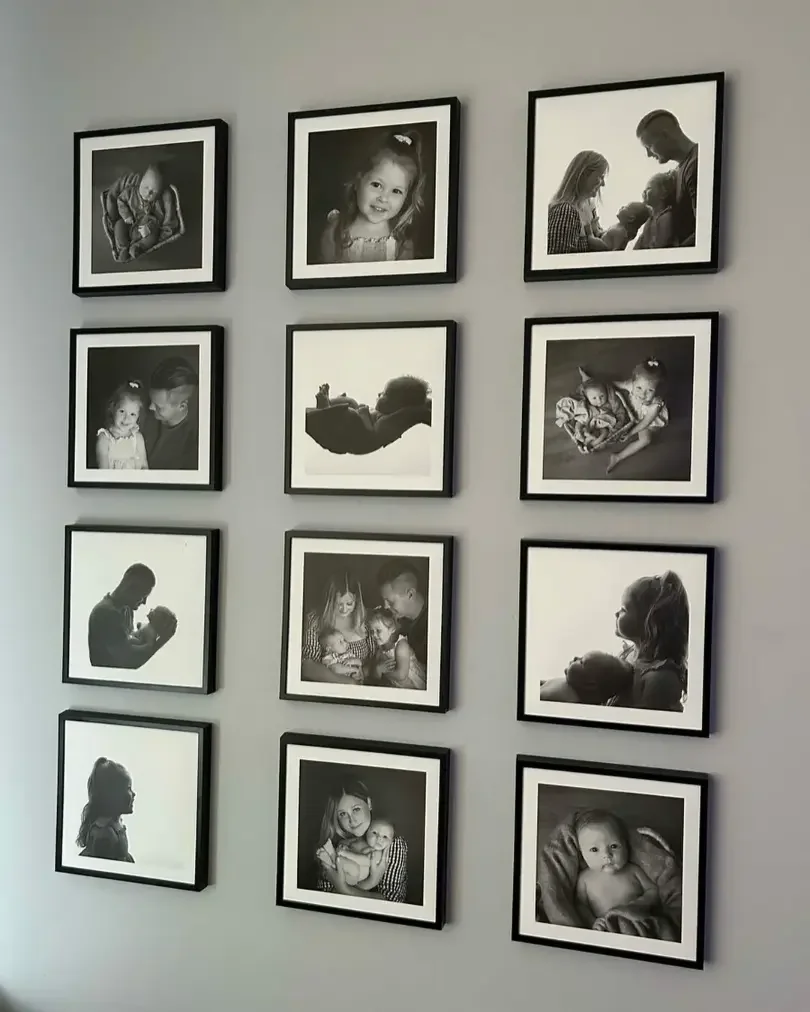
High-contrast designs with clean margins and generous negative space shine on square tiles. Consider a grid of botanicals or abstract faces, or mix illustrations with photo tiles for a curated photo gallery wall. Use Gallery Wall Kits to find balanced layouts fast.
Not sure which dimensions will look right in your room? Use our wall art size guide to pick tile sizes that feel balanced, then hang wall art without nails so you can fine-tune placement without damage. Planning a grid or salon-style mix of illustrations and photos? Follow our tips on how to arrange art on a wall for even spacing and clean alignment.
Recommended Mixtiles sizes for line art
|
Size (inches) |
Size (cm) |
Best For |
|---|---|---|
|
20.32 × 20.32 |
Minimalist icons and single-line portraits |
|
|
30.48 × 30.48 |
Botanicals and architectural contours |
|
|
12 × 16 |
30.48 × 40.64 |
Detailed hatching or stippling studies |
What is line art? It is proof that simple lines can say a lot about shape, motion, and mood. Sketch by hand, trace on a tablet, or convert a favorite photo, then print as Mixtiles to refresh your space anytime. No nails, no stress, just art you can rearrange as you grow.
Bring your line art to life. Upload your designs to Mixtiles and build one of our beautiful, movable gallery walls today.
Frequently Asked Questions
What are some iconic examples of line art?
Iconic line art spans centuries. Think Albrecht Dürer’s engravings and woodcuts, Hokusai’s ukiyo-e outlines, Henri Matisse’s fluid drawings, Pablo Picasso’s one-line portraits, and Keith Haring’s bold figures. Contemporary logo design and fashion sketches also rely on pure line to convey form, rhythm, and motion.
What are the main types of lines in art?
Artists commonly use horizontal, vertical, diagonal, curved, and zigzag lines, plus implied or dotted lines. These combine into techniques like contour drawing, hatching, cross-hatching, and stippling, which suggest edges, texture, and depth without gradients.
Who popularized modern one-line drawings?
One-line drawings have ancient roots, but Pablo Picasso popularized the modern, continuous-line approach in the 20th century. He showed how a single unbroken stroke can describe faces, animals, and movement with remarkable economy and character.
How do you create clean line art?
Start with a light sketch, then ink confident contours and vary line weight. Use hatching or stippling for tone, and keep generous negative space. Digitally, refine edges, remove noise, and export a high-resolution black-on-white file for crisp printing on Mixtiles.

Be the first to know — deals, news & decor ideas.
By clicking you agree to the Terms of Use & Privacy Policy